A doge's house, two brothers with Roman taste, and a collection that founded a museum
In the 16th century, educated Venetians argued about how far their city should follow the new Roman style of the Renaissance. The Grimani brothers settled the question for their own house: they rebuilt it as a Roman domus, filled it with ancient statues and hired artists who had worked in Rome.
The result is unlike any other palace in Venice. It also tells the story of one of the great Renaissance collections of antiquities, given away, scattered, and now partly reunited in the rooms it was made for.
The first building stands at the junction of the Rio di San Severo and the Rio di Santa Maria Formosa, an L-shaped medieval house with its main entrance on the water.
The merchant and statesman Antonio Grimani acquires the house. In 1521 he is elected Doge of Venice.
The palace passes to Antonio's grandsons, Vettore Grimani, later a Procurator of St Mark's, and Giovanni Grimani, Patriarch of Aquileia.
The brothers remodel the house in the style of an ancient Roman domus, and begin decorating it with frescoes and stucco by artists trained in Rome, including Giovanni da Udine and Francesco Salviati.
Vettore dies and Giovanni becomes sole owner. He adds a new wing that closes the courtyard into a square and continues the decoration, with Camillo Mantovano's Room of Foliage among the results.
Federico Zuccari decorates the monumental staircase with allegorical frescoes, grotesques and stucco copies of antique cameos from the Grimani collection.
Giovanni Grimani gives his ancient sculptures and gems to the Republic of Venice. After his death they go to the Marciana Library and later form the core of the National Archaeological Museum.
Michele Grimani dies without heirs and the Santa Maria Formosa branch of the family dies out. The palace changes hands and decays.
The Italian state buys the palace in poor condition. A long restoration brings back the frescoes, stuccoes and marbles, and the museum opens on 20 December 2008.
The 'Domus Grimani 1594–2019' exhibition brings Giovanni's sculptures back to the Tribuna. Since 2024 the palace belongs to the national archaeological museums of Venice and the Lagoon.
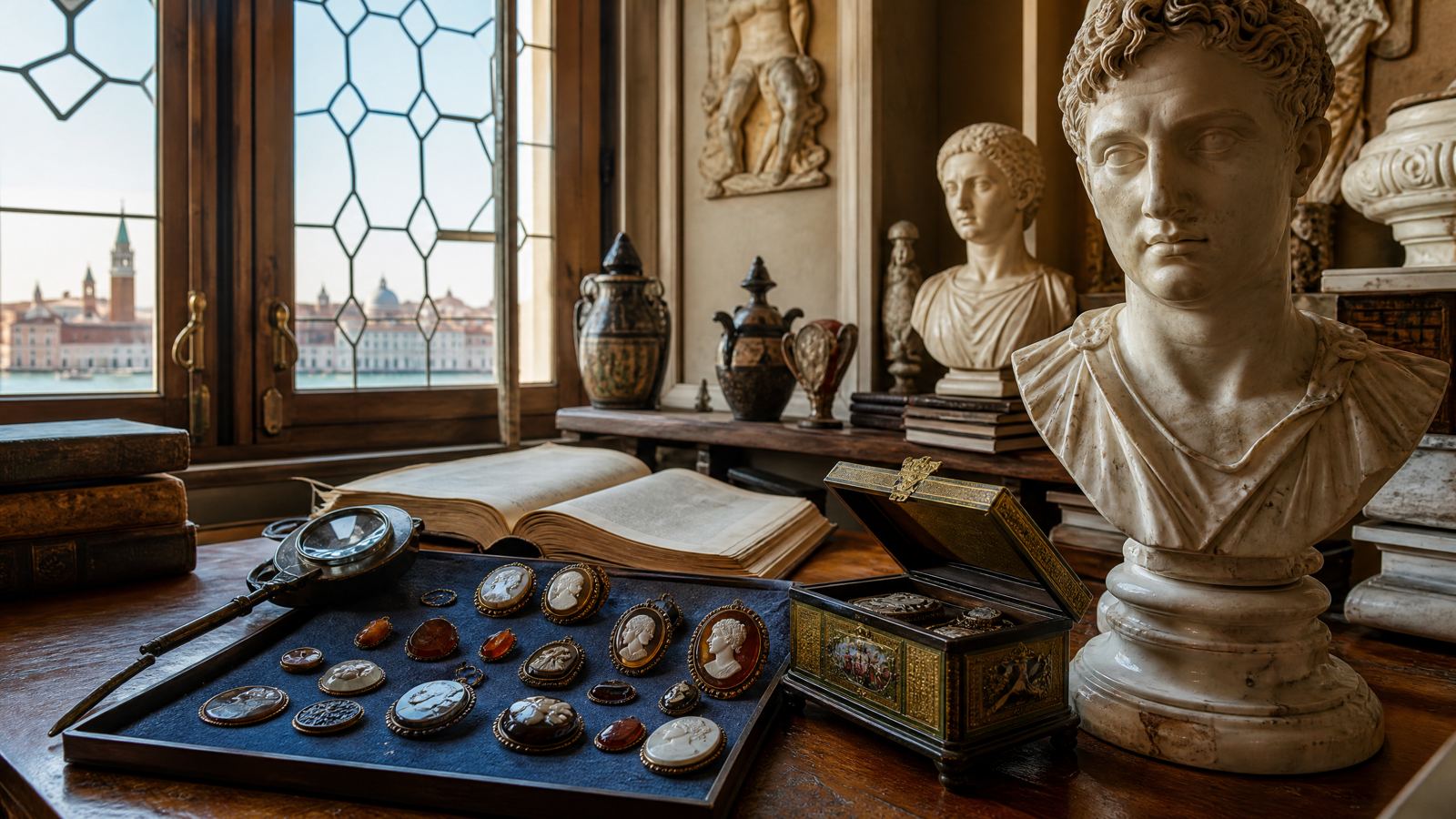
Patriarch Giovanni Grimani built one of the most admired collections of classical art in 16th-century Europe: statues and busts, marbles, bronzes, vases, coins and engraved gems, many acquired from Rome.
Giovanni designed the Tribuna to show the collection at its best: a square room lit from a coffered lantern, with sculptures arranged on brackets and in niches from floor to vault. It once held more than a hundred pieces. At its centre, a Roman marble group of Ganymede carried off by Zeus as an eagle hangs from the ceiling, as if flying out through the lantern.
In 1587 Giovanni left his sculptures and gems to the Republic. They went to the Marciana Library's vestibule and became the founding nucleus of the National Archaeological Museum on St Mark's Square. In 2019 many returned to the palace for the 'Domus Grimani' exhibition, and the museum now displays the patriarch's collection in the Tribuna and the rooms of the piano nobile.
Giovanni da Udine, Raphael's specialist in stucco and grotesques at the Vatican, worked on the small studies, including the Camerino di Callisto and the Camerino di Apollo.
Francesco Salviati, a Florentine painter active in Rome, painted frescoes in the Camerino di Apollo and the Psyche ceiling, now known from an old copy in the Sala di Psiche.
Camillo Mantovano painted the Room of Foliage in the 1560s, a ceiling turned into a garden full of animals.
Federico Zuccari, young and freshly trained in Rome, decorated the grand staircase in 1563–1565, and probably the grotesque monster of the Sala del Camino.
Together, these artists brought the language of Raphael's Rome into a Venetian private house a generation before it became common in the city. Art historians still argue over the meaning of many of the palace's symbols.
Many of Giovanni's pieces are still in the National Archaeological Museum, entered through the Museo Correr on St Mark's Square. Combine both for the full story.
Open Tuesday to Sunday, 10:00 to 19:00. €14, free for under-18s.